
How to Prepare for SSC CGL 2026: Complete Beginner-to-Advanced Guide


How to Prepare for SSC CGL 2026: Complete Beginner-to-Advanced Guide
The Staff Selection Commission Combined Graduate Level (SSC CGL) examination is one of the most popular government exams in India. Every year, lakhs of candidates compete for prestigious posts in ministries, departments, and government offices.
If you are serious about cracking SSC CGL 2026, this detailed guide will help you understand:
- SSC CGL exam pattern
- Subject-wise preparation strategy
- Best books and resources
- Time management
- Study plans
- Mock test strategy
- Mistakes to avoid
- Preparation tips for beginners and working professionals
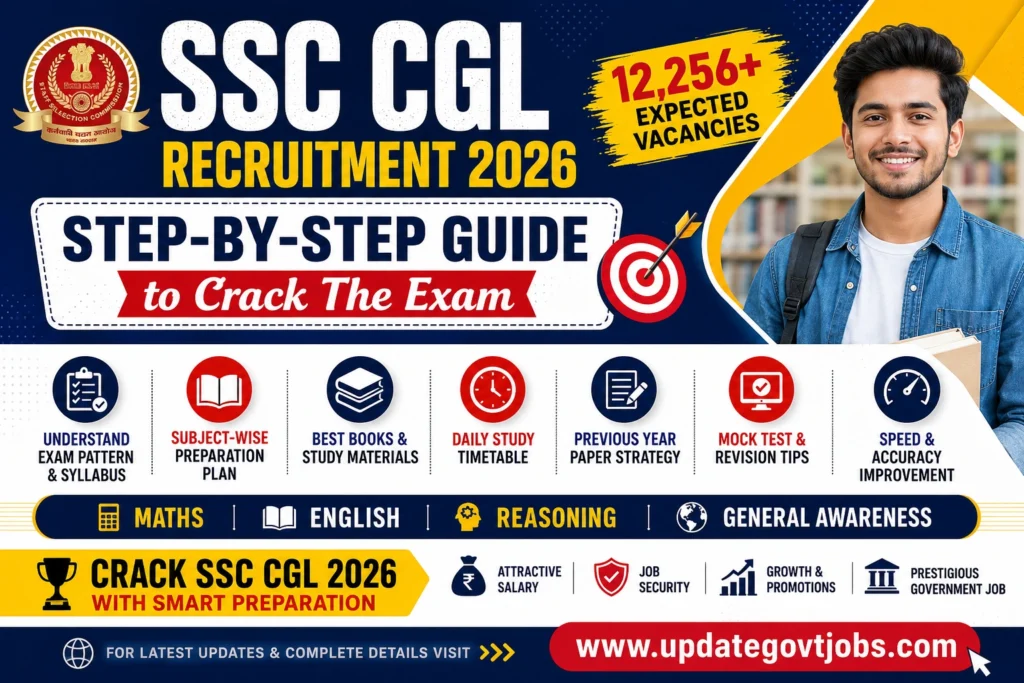
What is SSC CGL?
SSC CGL (Combined Graduate Level) is a national-level competitive examination conducted by the Staff Selection Commission to recruit candidates for Group B and Group C posts in various government departments.
Popular SSC CGL posts include:
- Income Tax Inspector
- Assistant Section Officer (ASO)
- CBI Sub Inspector
- Excise Inspector
- Auditor
- Accountant
- Preventive Officer
- Tax Assistant
Latest Govt Jobs.....
SSC CGL Exam Pattern 2026
The Staff Selection Commission Combined Graduate Level (SSC CGL) Examination is conducted in multiple stages to select candidates for various Group B and Group C posts in central government departments and ministries. The examination process mainly consists of Tier 1 and Tier 2 examinations.
Understanding the exam pattern is extremely important because it helps candidates:
- Prepare according to the latest syllabus
- Manage time effectively during the exam
- Understand the marking scheme and negative marking
- Focus on high-scoring sections
- Build a proper preparation strategy
SSC CGL is a computer-based examination, and both Tier 1 and Tier 2 are conducted online.
Purpose of Tier 1 Examination
Tier 1 acts as the screening stage of the SSC CGL recruitment process. The marks obtained in Tier 1 are mainly used for shortlisting candidates for Tier 2.
Since lakhs of candidates appear in SSC CGL every year, Tier 1 is highly competitive and requires strong speed management.
SSC CGL Tier 1 Paper Pattern :
| Subject | No. of Questions | Maximum Marks | Time Duration |
|---|---|---|---|
| General Intelligence & Reasoning | 25 | 50 | |
| General Awareness | 25 | 50 | |
| Quantitative Aptitude | 25 | 50 | |
| English Comprehension | 25 | 50 | |
| Total | 100 Questions | 200 Marks | 60 Minutes (1 Hour) |
Important Details of Tier 1 :
| Particular | Details |
|---|---|
| Exam Mode | Online (Computer-Based Test) |
| Type of Questions | Multiple Choice Questions (MCQs) |
| Total Questions | 100 |
| Total Marks | 200 |
| Exam Duration | 60 Minutes |
| Negative Marking | 0.50 Marks Deducted for Each Wrong Answer |
| Language | Hindi & English (Except English Section) |
| Difficulty Level | Easy to Moderate |
Key Features of SSC CGL Tier 1
1. Speed Matters the Most
Candidates get only 60 minutes to solve 100 questions, making time management extremely important.
2. Equal Weightage to All Subjects
All four sections carry equal marks, so candidates should not ignore any subject.
3. Negative Marking
Every incorrect answer results in a deduction of 0.50 marks. Therefore, blind guessing should be avoided.
4. Qualifying Nature
Tier 1 is primarily qualifying in nature for shortlisting candidates for Tier 2.
Purpose of Tier 2 Examination
Tier 2 is the most important stage of SSC CGL because:
- Final merit is mainly prepared based on Tier 2 marks
- It tests advanced aptitude and conceptual understanding
- It determines the final post allotment
Candidates aiming for top posts such as: Income Tax Inspector, Assistant Section Officer (ASO), CBI Sub Inspector, Excise Inspector, Auditor must perform exceptionally well in Tier 2.
SSC CGL Tier 2 Paper Structure
SSC CGL Tier 2 consists of multiple sections and modules.
Paper 1 (Compulsory for All Candidates)
Section 1
| Subject | No. of Questions | Maximum Marks |
|---|---|---|
| Mathematical Abilities | 30 | 90 |
| Reasoning & General Intelligence | 30 | 90 |
Section 2
| Subject | No. of Questions | Maximum Marks |
|---|---|---|
| English Language & Comprehension | 45 | 135 |
| General Awareness | 25 | 75 |
Section 3
| Module | Nature |
|---|---|
| Computer Knowledge Test | Qualifying |
| Data Entry Speed Test (DEST) | Qualifying |
SSC CGL Tier 2 Complete Paper Pattern:
| Section | Subject | Questions | Marks | Time |
|---|---|---|---|---|
| Section 1 | Mathematical Abilities | 30 | 90 | 1 Hour |
| Section 1 | Reasoning & General Intelligence | 30 | 90 | Included |
| Section 2 | English Language & Comprehension | 45 | 135 | 1 Hour |
| Section 2 | General Awareness | 25 | 75 | Included |
| Section 3 | Computer Knowledge Test | 20 | Qualifying | 15 Minutes |
| Section 3 | Data Entry Speed Test | Typing Test | Qualifying | 15 Minutes |
| Total | 150 Questions | 390 Marks | 2 Hours 15 Minutes |
Important Details of SSC CGL Tier 2
| Particular | Details |
|---|---|
| Exam Mode | Online Computer-Based Test |
| Total Questions | 150 |
| Total Marks | 390 |
| Total Duration | 2 Hours 15 Minutes |
| Negative Marking | 1 Mark in Some Sections, 0.50 in Others |
| Difficulty Level | Moderate to Difficult |
| Paper Nature | Merit Deciding |
Negative Marking in SSC CGL Tier 2
Negative marking in Tier 2 varies section-wise.
| Section | Negative Marking |
|---|---|
| Mathematical Abilities | 1 Mark |
| Reasoning & General Intelligence | 0.50 Marks |
| English Language | 0.50 Marks |
| General Awareness | 0.50 Marks |
Candidates should attempt questions carefully because excessive wrong answers can significantly reduce the final score.
Data Entry Speed Test (DEST):
The Data Entry Speed Test checks typing speed and accuracy.
- Candidates need to type approximately 2000 key depressions in 15 minutes.
- Qualifying only
- Marks are not added to merit
Computer Knowledge Test
The Computer Knowledge Test checks basic computer awareness such as:
- MS Word
- MS Excel
- Internet basics
- Operating systems
- Computer fundamentals
This section is qualifying in nature.
Difference Between Tier 1 and Tier 2
| Feature | Tier 1 | Tier 2 |
|---|---|---|
| Purpose | Screening Test | Final Merit Preparation |
| Difficulty Level | Easy to Moderate | Moderate to Difficult |
| Total Marks | 200 | 390 |
| Importance | Qualifying | Most Important |
| Time Duration | 1 Hour | 2 Hours 15 Minutes |
| Negative Marking | 0.50 Marks | 0.50 to 1 Mark |
Which Tier is More Important?
Tier 2 is more important because:
- Final selection mainly depends on Tier 2 performance
- Higher marks improve chances of getting top posts
- Competition level is much higher
However, candidates must first clear Tier 1 cutoff to appear for Tier 2.
Preparation Tips According to Exam Pattern
For Tier 1
- Focus on speed and accuracy
- Practice mock tests regularly
- Revise formulas daily
- Improve basic concepts
For Tier 2
- Focus on advanced practice
- Improve conceptual clarity
- Solve previous year papers
- Work on time management and accuracy
SSC CGL Syllabus in Detail
The SSC CGL syllabus is divided into four major subjects: Quantitative Aptitude, English Language, General Awareness, and Reasoning Ability. Candidates should prepare all subjects equally because each section carries significant weightage in both Tier 1 and Tier 2 examinations.
Below is the detailed SSC CGL 2026 syllabus :
SSC CGL Quantitative Aptitude (Maths) Syllabus
| Arithmetic Topics | Algebra Topics | Geometry & Mensuration | Advanced Maths & DI |
|---|---|---|---|
| Percentage | Basic Algebraic Identities | Lines & Angles | Trigonometry |
| Profit and Loss | Linear Equations | Triangle | Heights & Distances |
| Discount | Quadratic Equations | Circle | Data Interpretation |
| Ratio and Proportion | Surds & Indices | Polygon | Pie Charts |
| Partnership | Simplification | Quadrilateral | Bar Graphs |
| Average | Coordinate Geometry | Histogram | |
| Simple Interest | Sphere | Statistical Charts | |
| Compound Interest | Cone | Table Graphs | |
| Time and Work | Cylinder | ||
| Pipes and Cistern | Cuboid | ||
| Time, Speed & Distance | Hemisphere | ||
| Boat & Stream | Mensuration Formulas | ||
| Number System | Area & Volume |
| Grammar Topics | Vocabulary Topics | Reading Skills | Advanced English |
|---|---|---|---|
| Error Spotting | Synonyms | Reading Comprehension | Cloze Test |
| Sentence Improvement | Antonyms | Passage Understanding | Para Jumbles |
| Fill in the Blanks | One Word Substitution | Sentence Completion | Active & Passive Voice |
| Articles | Idioms & Phrases | Direct & Indirect Speech | |
| Tenses | Spelling Correction | Narration | |
| Prepositions | Word Usage | Sentence Rearrangement | |
| Subject-Verb Agreement | Vocabulary Building | Phrase Replacement | |
| Conjunctions | Homonyms | Grammar Usage |
| History | Geography | Polity & Economy | Science & Current Affairs |
|---|---|---|---|
| Ancient History | Physical Geography | Indian Constitution | Physics |
| Medieval History | Indian Geography | Parliament | Chemistry |
| Modern History | World Geography | Fundamental Rights | Biology |
| Freedom Movement | Rivers & Mountains | Indian Economy | Computer Basics |
| Important Dynasties | Climate | Budget & Banking | Space & Technology |
| Art & Culture | Agriculture | Government Schemes | Current Affairs |
| Historical Events | Natural Resources | Economic Terms | Sports |
| Important Personalities | Environment | Five-Year Plans | Awards & Honors |
| States & Capitals | Important Organizations | Important Days | |
| Census & Reports | Books & Authors |
SSC CGL Reasoning Ability syllabus:
| Verbal Reasoning | Non-Verbal Reasoning | Analytical Reasoning | Miscellaneous Topics |
|---|---|---|---|
| Analogy | Mirror Image | Statement & Conclusion | Coding-Decoding |
| Classification | Paper Folding | Syllogism | Blood Relations |
| Series | Embedded Figures | Decision Making | Direction Sense |
| Alphabet Test | Figure Completion | Puzzle Solving | Seating Arrangement |
| Word Formation | Pattern Recognition | Logical Venn Diagram | Ranking Test |
| Mathematical Operations | Counting Figures | Cause & Effect | Calendar |
| Dictionary Order | Cubes & Dice | Data Sufficiency | Clock |
| Missing Characters | Water Image | Assertion & Reason | Input-Output |
| Computer Fundamentals | Software & Applications | Internet & Networking | Cyber & Security Basics |
|---|---|---|---|
| Basics of Computers | MS Word | Internet Basics | Cyber Security |
| Input & Output Devices | MS Excel | Web Browsers | Viruses & Malware |
| Memory Devices | MS PowerPoint | Firewall | |
| Operating Systems | Computer Shortcuts | Networking Basics | Antivirus |
| Hardware & Software | File Management | Online Communication | Safe Browsing |
| Generations of Computer | Database Basics | Cloud Computing | Data Protection |
Important Points About SSC CGL Syllabus:
| Topic | Details |
|---|---|
| Level of Maths | 10th to 12th Standard |
| Level of English | Graduation Level |
| GK Coverage | Static GK + Current Affairs |
| Reasoning Difficulty | Easy to Moderate |
| Tier 2 Maths | More Advanced than Tier 1 |
| Computer Section | Basic Level |
Preparation Tips According to Syllabus
| Quantitative Aptitude | English Language | General Awareness | Reasoning Ability |
|---|---|---|---|
| Focus on formulas and shortcuts | Improve vocabulary regularly | Revise static GK frequently | Practice puzzles and logical questions |
| Practice calculations daily | Read newspapers and editorials | Follow monthly current affairs | Improve speed through mock tests |
| Solve previous year papers | Practice grammar exercises daily | Make short notes for revision | Focus on pattern recognition |
The SSC CGL syllabus is vast but manageable with proper planning and regular practice. Candidates should divide the syllabus into smaller topics and prepare systematically instead of studying randomly.
SSC CGL Study Material
Choosing the right books is extremely important for SSC CGL preparation. Candidates should avoid studying from too many resources and instead focus on a few high-quality books along with regular practice and mock tests.
Below is the subject-wise list of the most recommended books for SSC CGL 2026 preparation.
| Subject | Book Name | Author/Publication | Best For |
|---|---|---|---|
| Quantitative Aptitude | Fast Track Arithmetic | Rajesh Verma | Arithmetic Concepts & Shortcuts |
| Quantitative Aptitude | SSC Mathematics | Rakesh Yadav | SSC Pattern Practice |
| Quantitative Aptitude | Quantum CAT | Sarvesh Verma | Advanced Maths Practice |
| Quantitative Aptitude | Magical Book on Quicker Maths | M Tyra | Speed Maths Tricks |
| English Language | Plinth to Paramount | Neetu Singh | Grammar & SSC English |
| English Language | Objective General English | SP Bakshi | Complete English Preparation |
| English Language | Word Power Made Easy | Norman Lewis | Vocabulary Building |
| English Language | High School English Grammar & Composition | Wren & Martin | Grammar Fundamentals |
| General Awareness | Lucent’s General Knowledge | Lucent Publication | Static GK |
| General Awareness | NCERT Books (6th–10th) | NCERT | Basic Concepts |
| General Awareness | Manorama Yearbook | Malayala Manorama | Current Affairs & GK |
| General Awareness | Monthly Current Affairs Magazine | Various Publications | Current Affairs Revision |
| Reasoning Ability | A Modern Approach to Verbal & Non-Verbal Reasoning | RS Aggarwal | Basic to Advanced Reasoning |
| Reasoning Ability | Analytical Reasoning | MK Pandey | Logical Reasoning |
| Reasoning Ability | Kiran SSC Reasoning Book | Kiran Publication | Previous Year Questions |
| Reasoning Ability | Test of Reasoning | Edgar Thorpe | Concept Building |
| Computer Knowledge | Objective Computer Awareness | Arihant Publication | Computer Basics |
| Computer Knowledge | Computer Awareness | Lucent Publication | SSC Computer Preparation |
| Previous Year Papers | SSC CGL Previous Year Solved Papers | Kiran Publication | Exam Pattern & Practice |
| Mock Tests | SSC CGL Mock Test Series | Testbook / Oliveboard / PracticeMock | Speed & Accuracy Improvement |
Best Books According to Preparation Level
| Preparation Level | Recommended Books |
|---|---|
| Beginner | RS Aggarwal, Lucent GK, SP Bakshi |
| Intermediate | Rakesh Yadav Maths, Neetu Singh English |
| Advanced | Quantum CAT, MK Pandey Reasoning |
| Revision Stage | Previous Year Papers + Mock Tests |
Tips for Using SSC CGL Books Effectively
| Subject | Preparation Tip |
|---|---|
| Maths | Focus on formula revision and daily practice |
| English | Learn vocabulary and grammar rules regularly |
| GK | Revise static GK and current affairs weekly |
| Reasoning | Practice topic-wise questions daily |
| Mock Tests | Analyze mistakes after every test |
Important Advice for SSC CGL Aspirants
- Do not collect too many books.
- Stick to one standard book per subject initially.
- Solve previous year papers regularly.
- Revise short notes weekly.
- Focus more on practice than theory.
A combination of:
- Standard books
- Previous year papers
- Mock tests
- Revision
is enough to crack SSC CGL 2026 with a good score.
Best SSC CGL Preparation Strategy 2026
Cracking SSC CGL is not just about studying hard — it is about studying smart with the right strategy, consistency, and proper planning. Every year, lakhs of candidates appear for the SSC CGL examination, but only those with disciplined preparation and regular practice manage to secure top ranks.
A well-planned preparation strategy helps candidates:
- Cover the complete syllabus on time
- Improve speed and accuracy
- Reduce exam stress
- Perform better in mock tests
- Increase chances of final selection
Below is a complete step-by-step SSC CGL preparation strategy for beginners, working professionals, and full-time aspirants.
1. Understand the SSC CGL Exam First
Before starting preparation, candidates must understand the complete structure of the examination. Many aspirants directly jump into studying without understanding the syllabus and exam pattern, which leads to confusion and wasted effort.
| Preparation Step | Why It Is Important |
|---|---|
| Read the complete syllabus carefully | Helps identify important topics |
| Analyze previous year papers | Understands question patterns |
| Check topic-wise weightage | Focus on high-scoring areas |
| Understand exam pattern | Improves preparation planning |
| Know negative marking rules | Helps avoid unnecessary mistakes |
A proper study timetable is one of the most important parts of SSC CGL preparation. Instead of studying randomly, candidates should follow a fixed daily schedule.
| Strategy | Benefit |
|---|---|
| Study at fixed timings daily | Builds discipline |
| Divide time subject-wise | Ensures balanced preparation |
| Include short breaks | Prevents mental fatigue |
| Keep weekly revision sessions | Improves retention |
| Reserve time for mock tests | Builds exam confidence |
3. Follow the 3-Step SSC CGL Preparation Formula
Successful SSC CGL preparation mainly depends on three stages:
- Learning Concepts
- Practicing Questions
- Mock Test Analysis
Candidates should repeat this cycle regularly throughout preparation.
Mock Tests & Analysis
Mock tests are the real game changer in SSC CGL preparation. They help candidates experience the actual exam environment before the real examination.
| Benefit | Explanation |
|---|---|
| Improves speed | Helps solve questions faster |
| Increases accuracy | Reduces silly mistakes |
| Builds confidence | Removes exam fear |
| Identifies weak areas | Helps improve poor topics |
| Enhances time management | Improves question selection strategy |
Previous year papers are one of the most valuable resources for SSC CGL preparation because SSC often repeats:
- Question patterns
- Concepts
- Difficulty levels
- Static GK facts
Benefits of Solving Previous Year Papers
| Benefit | Description |
|---|---|
| Understand exam trends | Know frequently asked topics |
| Improve speed | Develop quick-solving ability |
| Increase confidence | Familiarity with exam pattern |
| Identify important topics | Focus on repeated concepts |
Candidates Should Solve:
- Last 5–10 years SSC CGL papers
- Tier 1 and Tier 2 papers
- Topic-wise previous year questions
Final SSC CGL Preparation Advice
Success in SSC CGL depends more on consistency than intelligence. Candidates who study regularly, revise properly, and practice mock tests sincerely usually perform much better than those who study irregularly.
Golden Rules for SSC CGL Preparation
| Rule | Importance |
|---|---|
| Stay consistent daily | Builds long-term improvement |
| Revise regularly | Prevents forgetting |
| Attempt mocks seriously | Improves real exam performance |
| Focus on accuracy first | Speed improves gradually |
| Avoid too many resources | Prevents confusion |
SSC CGL preparation becomes much easier when candidates follow a structured strategy instead of random studying. A balanced combination of Consistency, discipline, and smart preparation are the real keys to success in SSC CGL.
Motivation for SSC CGL Aspirants
SSC CGL preparation is a marathon, not a sprint.
Some days will feel difficult, but consistency always beats temporary motivation. Even 5 focused study hours daily for one year can completely change your career.
Remember:
- Small daily improvements create big results
- Mock test failures are learning opportunities
- Discipline matters more than talent
How to Apply
Candidates who are interested in applying for SSC CGL Recruitment 2026 can check the complete notification, eligibility criteria, vacancy details, important dates, exam pattern, syllabus, and step-by-step application process through the official detailed article available on Update Govt Jobs.
SSC CGL Recruitment 2026: Total 12,256 Posts Apply Online
The article provides complete guidance for candidates preparing for one of India’s biggest government recruitment examinations with approximately 12,256 vacancies announced for various Group B and Group C posts.
For complete details, eligibility criteria, and instructions, please visit the official website:
FAQ :
Is SSC CGL difficult?
SSC CGL is competitive but manageable with proper preparation and consistency.
Can I crack SSC CGL in 6 months?
Yes, with disciplined study and mock practice.
Which subject is most scoring?
English and Reasoning are generally the most scoring sections.
How many hours should I study daily?
5–8 hours is ideal for full-time aspirants.
Are NCERT books necessary?
NCERTs are useful mainly for General Awareness and basic Maths concepts.